S · G · F · S
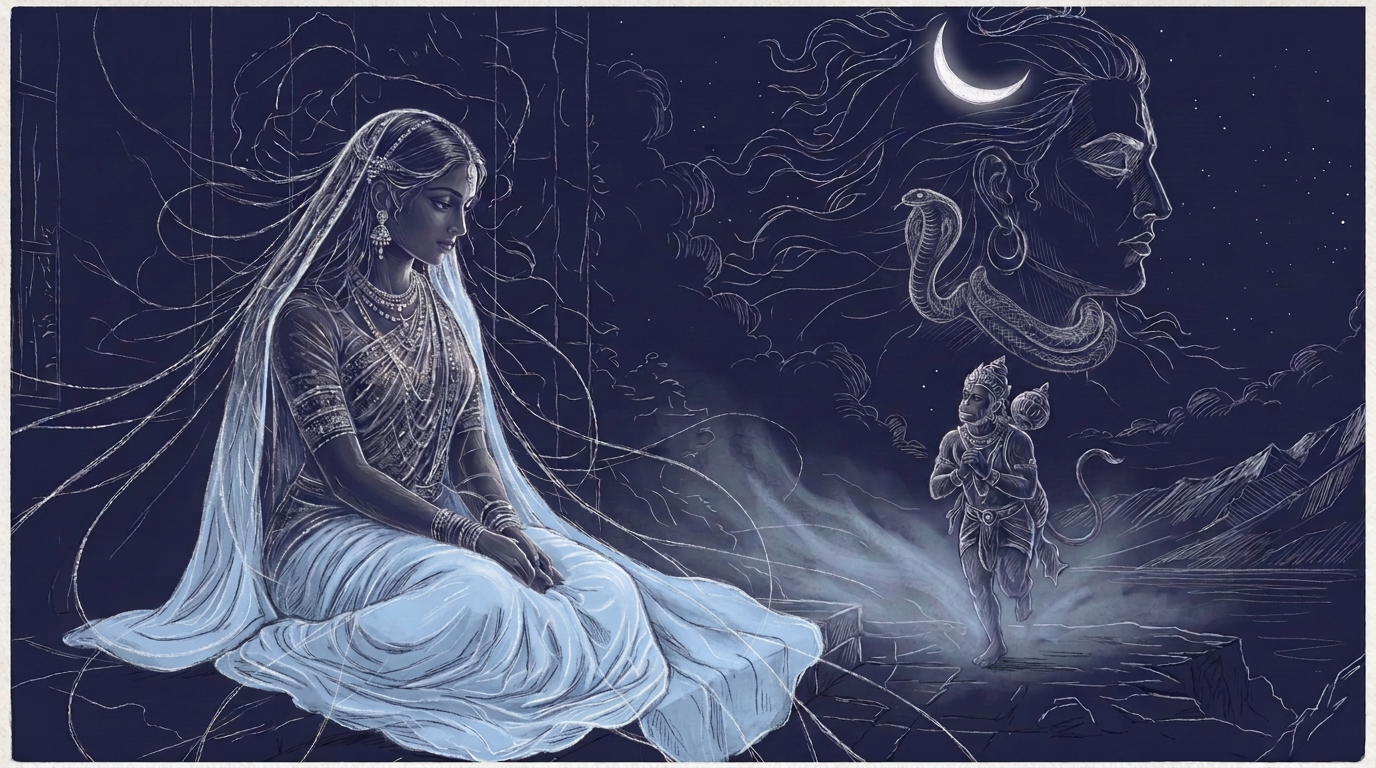
Goddess Sita glowing with silver threads of inner light, an indigo night sky and a crescent moon in distant divine dreadlocks behind her

Readings are short, altered myths that gather gods and goddesses from different spiritual traditions. It is an invitation for them to become more for us, and for us to find them inside of us.

Readings are an invitation for a dance drama workshop.

Reading No. 01

Goddess Sita

With a little help from unexpected gods, Hanuman rescued Sita.

Sita, the smart, decisive, loving and dutiful wife of Ram, was kidnapped by Ravan, the strongest demon of all. It was natural…Ravan desired Sita. Her ethereal beauty was not simply her physical form. It was an energy that bloomed from the inside. An electrical beauty that spun soft, thin metallic threads, millions of them from within, and this constant spinning was a hum, barely noticeable, but definitely present, like a carefully plucked note from a harp. It vibrated a single melodious note without end. This soft, electrical sound and sight reflected from the crown of her head to her tiptoes.

Ravan was smitten, and because he was a demon, the only way to acknowledge such beauty was to conquer it. Beauty, as all demons knew well, was to be owned, encased, pillaged, torn apart and put together at their will. Essentially, demonized. Ravan, with his ten heads, was a collection of compounded anger and envy, and he wanted Sita like nothing he had ever wanted before in all the lifetimes he had already lived. He had lived millions of them.

Ravan lured Sita away from her home in the forest, swiftly. So swiftly that the oil lamps in all the homes sputtered out, singeing their last breath. The forest homes and all the homes beyond it experienced sudden and utter darkness. Since Ravan’s chariot traveled in the uppermost layers of the cosmos, it could not be seen by Sita’s husband, Ram, or by his brother, Lakshman. Gods who lived in the numinous were the only ones who could sense Sita. And, in this case, it was felt most intensely by one in particular. Shiva. And that’s only because a chariot flying through the uppermost layers of the cosmos had disturbed the moon that lay resting in Shiva’s dreads, healing itself from an annoying cold. The moon saw Sita’s current like lightning, and began to cry. Shiva slanted open his eyes slightly, and understood there was trouble as the moon’s milk descended his body. He then felt the snake travel up his chest and slither around his neck. It had been a minute since Naag had cozied up around Shiva. Naag’s hood was flared, and as he circled up and around Shiva’s torso, the jewel in the hood shone a powder blue so brightly that Shiva’s slit eyes widened — a strange concentrated depth in them. He came with news, of course. From the Goddess of the Universe, Mary. She was often, but not always, found inside the walls of the deep roots of trees, or, like a thin blue line in the crevices of stones and minerals. Occasionally, she crawled out, walked across the Earth and climbed up to the top and stood there.

Goddess Mary,

Mother of the Universe.

On this occasion, Mary was pounding seeds for tea for the roots to drink, and she was livid. Mary’s blue mantle softly hung, circling the walls of the tree, and Naag cautiously wound himself in it. He didn’t particularly enjoy how pieces of roots spat out of the pestle and onto his skin. Mother Mary glanced over. He sighed; his rest was short-lived. In one glance he understood. About Sita. He slipped out of the blue mantle as quickly as he had wrapped himself in it. Charged with her message, Naag began his journey upward, eager to get to the mountainous torso of Shiva.

Shiva understood what he had to do. He summoned Hanuman with his dumroo. Hanuman, the monkey god who had inconveniently forgotten he was a god…and needed to be reminded. There was a goddess in need of saving, a goddess who was the daughter of the Mother Goddess upon whom the Universe stood anchored. Since Hanuman had forgotten he could fly, Shiva slipped himself into Naag and descended to the monkey forest and found Hanuman lost in deep love for gods he had yet to meet. With the end of his body, Naag drew a circle around Hanuman. As Shiva began relating the kidnapping of Goddess Sita, Hanuman began to remember what he had forgotten. His chest expanded, and the image of the gods he loved and yet had to meet began to glow at his sternum.

Naag guided Hanuman to a column of trees. Once he sized himself as small as a caterpillar, he crawled down. Further and further down. Eons below, he found the color blue. Mary’s mantle. She gathered him in her blue garment, sang him a song, and anointed him with jasmine oil. The song and the oil released stories he was meant to hear...about a journey of searching that he had already begun, of seeking a presence whose electricity is the numinous language carried in the meridians…like phantoms from the highest to the lowest ends of the cosmos. Back and forth. Up and down. Dancing to the phantom monosyllabic songs of the meridians. Hanuman set off on his journey. To find the Goddess Sita.

In bringing her back, he would restore the numinous universe to its delicate balance of phantom play.
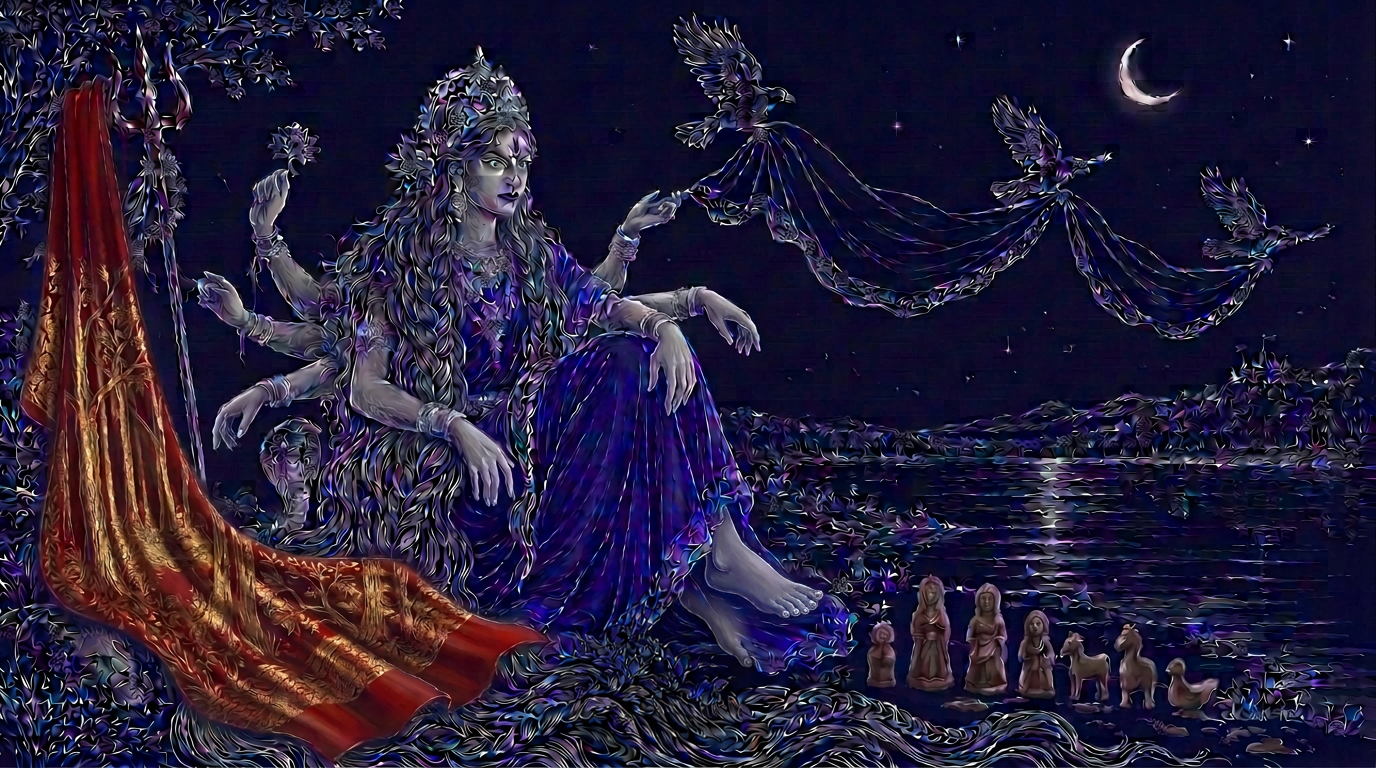
Goddess Durga seated on a riverbank in a lapis-blue sari, crows carrying the blue cloth, a serpent coiled nearby and small clay dolls lined up by the water
Reading No. 02

Goddess Durga in a Blue Sari

Her trident glistened red, warm still with Mahishasura’s blood. For nine nights Durga continuously fought Mahishasura’s armies. She followed his shape shifting like a wolf on a scent. Mahishasura, a buffalo demon, shape shifted into a lion, a human carrying a sword, and an elephant whenever he felt danger was close by. He loved coming close to it. Just inches away from one of Durga’s arms, and still he escaped…with delight, with glee, with a satisfaction that was akin to satiating a deep hunger.

As the story goes, Mahishasura had won a boon from Lord Brahma for the heavy duty meditation he bestowed upon the god of creation. The gods believed that intense discipline of prayer warranted a boon, no matter how toxic the motivations may be. Mahishasura was an asura, and as such, his demonic hunger was insatiable. His desire was empty of beauty, and as such gratification, be it sexual or violent, had no end point.

Brahma granted him the closest reward to immortality: that he would not be defeated by a man, a god, or an animal. His thirst for conquering the 3 realms (Earth, the astral plane between Earth and Heaven, and Heaven itself) could only be quenched if he turned the cosmic order on its head. The aim of his violent disruptions was to cause pure chaos to ensue as a strict discipline. His body shivered pleasurably because everything succumbed to him, including the gods of the 3 realms.

For the most part, battles are not won physically, but through mental clarity. Durga knew Mahishasura was all fear. Fear energy can become as large as universes, and it is empty except for itself. It has only its darkness as companionship. When fear multiplies itself exponentially, it is an immeasurable hollowness.

Durga shifted the pallu of her deep red sari over her shoulder, grabbed its end to wipe off the sweat from her brow. She gathered her thick hair into a thick bun. A deer strolled over and bent his head, and offered Durga an antler tine to secure her bun. Sita’s pet, chuckled Durga to herself. Her sister of the cosmos. A cosmos that had been ripped, shredded, and emaciated to such a thinness it was unable to recognize itself.

She sighed with relief. The end of Mahishasura was now the beginning of a slow, deep, and massive renaissance of the 3 cosmic realms. She could hear the ground under her feet…Mother Mary’s pounding of ancient tree resin back into a liquid state, and the roots drinking it from the palms of her hands. Revival.

Mother, Mother Under My Feet, I Can Feel Your Heartbeat Under My Feet…

Durga unraveled the red sari and hung it over a tree’s branches. Crows came swooping down with a blue silk sari. A specific blue color it was…if lapis-lazuli were crushed into powder then mixed into water, that would be the color of cloth that embraced her body. The crows arrived singing a complex rhythm of clicks and rattles. She shook out her hair again and matched their birdsong with her own guttural rhythms, singing in tones that climbed into and under skin, searing through membranes, and sliding and nestling next to bone. The crows circled the fabric around her waist, pleated it between their beaks and tucked it near her navel.

Durga leaned toward a berry bush, pulled off a few blue ones and pressed them against her forehead. She smeared the juice into a long blue tika.

Durga felt the presence of Naag at her sacrum. Naag, the serpent that traveled through all the cosmic realms, wound itself toward her tailbone and nudged her. Her sacrum broadened, lengthening her side ribs, elongating her spine. Knowingly, she walked toward the river bank and sat down. She picked up a reed, sliced it open, and dipped the slit into more crushed berries. With another hand she pulled a dried palm leaf that was pressed under a rock, and began to compose her letter to the two gods who sat at the threshold of it all.

Janus, the Roman god of beginnings, passages, doorways, transitions, and endings. He had two faces, each facing in opposing directions. Janus was a threshold. He was the door and its hinges between Before and After, Past and Future. Ganesha was the Hindu god who removed obstacles. He, too, presided over the threshold moment, the passageway, the moment of crossing.

Her Letter to Ganesha and Janus

To Ganesha, remover of what is in the way, and to Janus, who watches in both directions simultaneously—I write to you to tell you that I have done something that only the two of you understand more than any cosmic being—I have closed a door. Mahishasura, the shape shifter, is dead. With the talismans of all the gods in my arms, I have ended the life of something that defied an ending.

Yet, I am unsettled, and while there is finality of Mahishasura’s body, there is something he did not take with him. His Shadow. He has left behind his fear. I closed a door, Ganesha and Janus. However, within this bright new beginning a Shadow shifts stealthily. It does not need my eight arms and gods’ talismans. It needs a different type of shape shifter.

It needs Beauty. Something that cannot be grasped or contained. It shifts continuously, and it asks for attention as soon as it is lost. However, it is not so easily found. Beauty will be elusive. Because of forgetfulness, because of the weight all humanity will carry. There is an inheritance that humanity will suffer. A legacy of:

self-doubt,
punishment, and
hunger for validation.

Fear is about Never Arriving.

Beauty is about Continuously Arriving
again and again Arriving.

Ganesha, Janus: You will watch the beings of the 3 cosmic realms become what they could not at each passing. With my teaching, you will notice each being of the 3 cosmic realms lighten and embolden when each and all of them stand at any and all thresholds. A piece of Shadow will fall off the shelf of their shoulders.

Durga ended her letter here. She entrusted the river to carry the palm leaf. The palm leaf was bound to disintegrate; the crushed berry juice writing would fade. It didn’t matter. The words in the letter would arrive anyway. Ganesha sensed this invocation as essential to a beginning. Janus was the river. Janus was the passageway.

She then began to compose her song. Her Suktam. Her hymn for Arriving, to be left there at the bank of the river, and spread.

Mitti and Her Hymn for Arriving

Durga gathered some river water and some mitti. She mixed both until it felt like clay between her fingers, and began to shape dolls. She molded them and defined them with different length torsos, heavy and thin bosoms, high and low foreheads, flat-footed and arched, tapered fingers, and some curled almost into fists.

Durga sang as she crafted. She embodied her name. She became the “dur,” meaning “hard,” and the “ga,” meaning “go.” Singing a song that lifted her name outside of suppression. Her Suktam. Durga Suktam. It was spun into existence out of necessity. It was spun to let all beings know how to be Durga. Words that guide all beings. First they are descendants, and eventually ancestors. All descendants and ancestors would learn to go through the hard. Go through the difficult and the arduous, the grim.

Sing Me, says Durga. Sing my Suktam.

Durga invoked Agni, the god of fire, the knower of all things: Jatavedase (all-knowing) to ferry people across their troubles, like a boatman. Then, Durga asked for protection of their bodies, their children, their crops and their land. Ferry all, transport everyone across their miseries, she sang, and let them all feel the divine fire that will fill all with bliss. All this to arrive into a pure consciousness.

Burn the Shadow that all humanity will be lured to cloak itself in, and let there be an arrival into the Beauty (the truth). Let there be this arrival by shucking off the grip.

Durga sang, and molded dolls out of mitti. She kept singing and kept molding dolls, knowing that all this will return to the river and dissolve. She will keep singing and keep molding dolls out of mitti. Durga is all of it: she is the invocation for the new beginning, for Agni, and the embodied safe passage filled with prayers for protection, healing, and release.

Durga Suktam.